San Mateo County MHSA (Prop 63)
Mental Health Services Act (MHSA)
Sign up to receive e-mail updates for this page
The Mental Health Services Act (MHSA), Prop. 63, was passed by California voters in 2004. It has provided a dedicated source of funding for transforming the delivery of county behavioral health services. Here is a look back at the transformational impact MHSA has had in San Mateo County over the past 15 years: MHSA Impact Report and Infographic.
Behavioral Health Services Act (BHSA) Goes Live July 1, 2026!
Prop. 1 – BHSA was approved by voters in March 2024 and includes new requirements for MHSA funding allocations and impacts across the behavioral health continuum of care. Learn more about our local approach to the transition from MHSA to BHAS and how to get involved:
Announcements
Three-Year Integrated Plan – Approved
On June 9, 2026, the San Mateo County Board of Supervisors voted to adopt a resolution authorizing the approval of the BHSA Three-Year Integrated Plan.
- San Mateo County BHSA 3 Yr Integrated Plan FY26-FY29 - updated 7/21/26
- BHSA Three Year Integrated Plan Slide Deck
How to Give Public Comment
- Quick Tips – How to Give Public Comment at a public meeting
- Online Form
- Email to mhsa@smcgov.org / optional downloadable form
- Leave a phone message at (650) 573-2889
How to Get Involved and stay informed!
- Sign-up to receive MHSA emails from this website; link above
- Join one of many Standing Committees
- View the monthly Director’s Update provided to the commission
- Subscribe to the BHRS Blog
- For funding opportunities, sign up with OpenGov to receive notifications
About MHSA
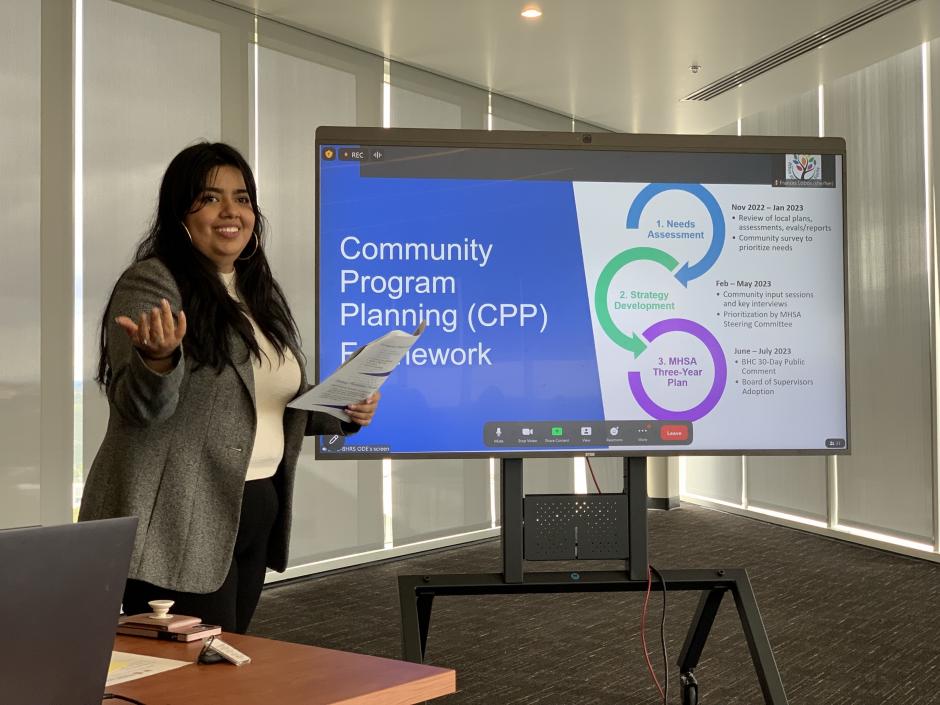
Counties are required to submit Annual Updates and Three-Year Plans that are developed in collaboration with clients, family members of clients, community members and other stakeholders; this process is known as a Community Program Planning (CPP).
MHSA Issue Resolution Process Policy
An Issue Resolution Process Policy has been adopted to resolve specific MHSA issues related to:
- The Community Program Planning (CPP) process
- Consistency between approved MHSA plans and program implementation
- The provision of MHSA-funded programs and services
In San Mateo County, the Office of Consumer and Family Affairs (OCFA) manages service/treatment grievances for BHRS and therefore MHSA issues will be routed through the formal OCFA Grievance process. The MHSA Issue Resolution Process policy is focused on grievances related to the planning and implementation of MHSA specifically.
MHSA Components
Community Services & Supports (CSS)
CSS activities focus on providing direct services and treatment to people of all ages living with serious mental illness. At least 51% of CSS dollars have to be spent on full service partnerships, which provide 24/7 wraparound services for individuals living with serious mental health challenges.
Prevention & Early Intervention (PEI)
PEI activities target individuals of all ages prior to the onset of mental illness, with the exception of programs focusing on early onset of psychotic disorders. At least 51% of PEI dollars have to be spent on programs for children and youth ages 0-25.
Innovation (INN)
The MHSA INN component allows counties to apply for funds for innovative projects that are implemented for 3-5 years and evaluated to develop new best practices in behavioral health.
- MHSA INN One-pager
- Summary of INN Project Implementation in San Mateo County
New Innovation Project Plans
The following four INN projects are currently active:
- Peer Support for Peer Work – project brief
- Animal Fostering and Care for Housing Stability and Wellness - project brief
- allcove Half Moon Bay - project brief;
- PIVOT – developing capacity for MediCal billing - project brief / FAQs
- Adult Residential In-home Support Element (ARISE) - project brief
- Mobile Behavioral Health Services for Farmworkers - project brief
- Music Therapy for Asian/Asian Americans – project brief
- Recovery Connection Drop-In Center – project brief
- PIONEERS – Pacific Islanders Organizing, Nurturing, and Empowering Everyone to Rise and Serve – full proposal
Previous completed INN projects final reports for are available under the Evaluation Reports tab.
Workforce Education & Training (WET)
WET programming includes training, education, programs and policies to assist in the engagement and selection of a diverse workforce that includes consumers, families, and community members and schools. Visit the BHRS WET website to learn more about the programs and services.
Housing
The MHSA Housing Program was established to create permanent supportive housing for individuals living with serious mental health challenges who are homeless or at risk of homelessness. Since 2006, the funding has led to 72 supportive housing units developed in San Mateo County. Visit our MHSA Housing page for more information and the most recent MHSA Housing Initiative.
Capital Facilities & Technology Needs (CFTN)
The CFTN component funded e-Clinical Care, an integrated business and clinical information system (electronic health record) as well as ongoing technical support. Currently, CFTN funds devices with data plans for clients to engage in telehealth and recovery services online.
Community Program Planning (CPP)
Current MHSA Three-Year Implementation Phase:
July 1, 2023 – June 30, 2026
Annual Updates Due: June 30th of
each year
New BHSA Planning Phase Begins: January 2025
New BHSA Three-Year Integrated Plan Due: June
30, 2026
The CPP process involves clients of behavioral health services, families of clients and other community stakeholders in planning, implementation and evaluation activities of MHSA funded programs.
MHSA Workgroups
The MHSA Steering Committee hosts two workgroups per year. Workgroup members provide input in planning new services and recommendations for improvements on prioritized topics.
-
MHSA Outcomes Workgroup (Fall 2024)
- Workgroup #1 (10/10/24) – agenda, slide deck, meeting notes
- Workgroup #2 (11/14/24) – agenda, slide deck, meeting notes
- Workgroup #3 (12/12/24) – agenda, slide deck, meeting notes
- Optional Workgroup #4 (1/23/25) - recommendations
-
MHSA Communications Workgroup (Fall 2023)
- Workgroup #1 – slides
- Workgroup #2 – focus group
- Workgroup #3 – campaign slides and performance report
-
MHSA 3-Year Plan Workgroup (Fall 2022)
- Workgroup #1 - slides, needs assessment review
- Workgroup #2 - slides, notes, needs survey results
- Workgroup #3 – slides, facilitator training
- Innovation (INN) Workgroup (Spring 2022)
-
Full Service Partnerships (FSP)
Workgroup (Fall 2021)
- FSP Workgroup final recommendations
- November 4th – slides, notes
- October 7th - slides + pre-meeting handout, notes
- September 2nd - slides + FSP client and FSP provider input
- Housing Initiative Taskforce (Spring 2021) – final recommendations and materials
Steering Committee
MHSA Steering Committee Meeting Materials for the planning and implementation of the current Three-Year Plan: July 1, 2023 – June 30, 2026
- Materials for February 6, 2025; Meeting Notes & Attendance
- Materials for December 5, 2024 ; Meeting Notes & Attendance
- Materials for September 5, 2024 ; Meeting Notes & Attendance
- Materials for May 2, 2024; Meeting Notes & Attendance
- Materials for February 8, 2024; Meeting Notes & Attendance
- Materials for December 7, 2023; Meeting Notes & Attendance
- Materials for September 7, 2023; Meeting Notes & Attendance
Evaluation Reports
Full Service Partnerships (FSP)
- FSP Outcomes: FY 2024-25, FY 2023-24, FY 2022-23, FY 2021-22, FY 2020-21, FY 2019-20
Prevention & Early Intervention (PEI)
- PEI 3-Year Reports: FY 2021-24, FY 2018-21, FY 2016-18
Innovation (INN)
- Adult Residential In-home Support Element (ARISE): Year 2,Year 1
- Farmworker Equity Express: Year 2, Year 1
- Music Therapy for Asian/Asian Americans: Year 2, Year 1
- Recovery Connection Drop-In Center: Year 2, Year 1
- PIONEERS: Year 2, Year 1
- Kapwa Kultural Center and Café: Final Report
- Help@Hand:
- The Pride Center: Final Report
- Health Ambassador Program for Youth (HAP-Y): Final Report
- Neurosequential Model of Therapeutics (NMT) in an Adult System of Care: Final Report
Three-Year Plans, Annual Updates and Expenditure Reports
MHSA Three-Year Plan & Annual Update
- Annual Update (data from FY 24/25) – report
- Annual Update FY 25/26 (data from FY 23/24) - presentation slides / executive summary / approved plan
- Annual Update FY 24/25 (data from FY 22/23)- presentation / executive summary / approved plan / approved amendment
- Three-Year Plan FY 23/24 to FY 25/26 & Annual Update FY 23/24 - presentation / executive summary / approved plan
Annual Revenue and Expenditure Reports (ARER)
- Fiscal Year 2024-25 ARER
- Fiscal Year 2023-24 ARER
- Fiscal Year 2022-23 ARER
- Fiscal Year 2021-22 ARER
- Fiscal Year 2020-21 ARER
- Fiscal Year 2019-20 ARER
- Fiscal Year 2018-19 ARER
- Fiscal Year 2017-18 ARER
- Fiscal Year 2016-17 ARER
- Fiscal Year 2015-16 ARER
- Fiscal Year 2014-15 ARER
- Fiscal Year 2013-14 ARER
- Fiscal Year 2012-13 ARER
MHSA Administration and Components: 20-09
Other
Policy: 20-09 MHSA Administration and Components
: MHSA Steering Committee Roles and Responsibilities